Saturday, October 7, 2017

Blog 3 - Kelley Newkirk

Wah, L. M. (Director). (n.d.). Color of Fear [Video File]. Retrieved from
          http://www.stirfryseminars.com/store/cast_cof.php

Skillings, Judith H., Dobbins, James E. (1991). Racism as a disease:  Etiology and treatment  
            implications, Journal of counseling and development (70), 206-212.

Proctor, Enola K, Davis, Larry E.  (1994). Racism as a disease:  The challenge of racial difference:
Skills for Clinical Practice, Social Work (39:3), 314-323.


I found Color of Fear both moving and enlightening.  First, Victor, David L., and David C. expressed such a breadth of emotion and eloquence in their discussion of race.  Victor's speech at approximately 17min into the film when he shouts out to the room that he is considered "unpalatable to this goddamn nation…there is no American ethnicity…you give up your ethnicity to become American" is something that will stick with me.   Victor's view of racism is consistent with Skilling, et al's discussion that racism is characterized by the belief that one group's heritage is superior and the "superior" group uses power to maintain their superiority.  David's responses to Victor in the first hour or so of the film make it clear that David is guilty of white supremacy and racism as defined by Skilling.   David just doesn't realize or want to acknowledge his power.  David's position that Victor and other people of color are responsible for putting up the roadblocks between themselves and white people, that white men don't have the same camaraderie as people of color, and that his (David's) daughters are at a disadvantage because they aren't awarded extra points in the college application processes are all examples of David's covert racism. 

As the Color of Fear drew towards its conclusion, I was confident that there was no hope for David.  He was so firmly entrenched in his opinions, and so well cloaked in his white privilege that I didn't think he'd be able to move forward.  When Wah asked David how he would feel if someone suggested his daughters work a little harder for those points I could see David begin to shift.  I believe that David doesn't want to be racist, and his involvement in the film may have helped him think more broadly about race.   Skilling, et al offer an approach that may have been helpful to David.  Thinking about racism as a disease, something you're born with or catch vs. something you're at fault for, would be very healing for David.   He's responsible for healing himself, but he's not at fault for being racist.


I recognized in my first blog and in my self-reflection essay that I have racist tendencies.  Unlike David, at least in the beginning of the film, I do recognize my biases.  I was very interested in Proctor and Davis's discussion on how to develop racially sensitive skills as I hope to work in a clinical setting.  I think it is essential as a white person to recognize and acknowledge the profound segregation that still exists in our country.   Segregation, by definition, prohibits understanding and cross-race communication.  As a practitioner, I will have to approach clients that are of a different race than from a position of informed not knowing and seek ways to build trust.

Friday, January 15, 2010

Resolving Our Resolutions

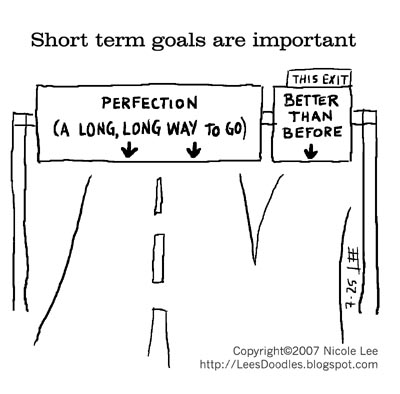
2007_07_25_short_term_goals
How many of you out there made lofty New Year's resolutions that have already fallen by the wayside? Did you set a goal to go to the gym 4 times per week, but only made it once or twice this month? Did you pledge to eat healthfully, but were back to your old ways by January 3rd? Or, maybe you committed to giving up a vice like smoking, alcohol, coffee, etc. and are still smoking, drinking, you name it. Does any of this sound familiar to you? If so, then read on...


I firmly believe in resolutions at the beginning of each new year. Traditionally it is a time for reflection and hope for what's possible in the new year. Making commitments to oneself is an empowering and healthy act. However, most of us give up on our resolutions before we've even made it out of January and then feel guilty or inadequate. So, what happens to all of the hope and determination we had on January 1st? I believe 3 things get in the way of keeping our commitments to ourselves.

First, we don't have a sustaining vision of what life will be like if we keep our resolutions. To stay fully committed to a lifestyle change we have to be invested in the goal. We have to be able to easily visualize how great our life will be once we've succeeded. For example, if your goal is to lose 20 lbs, then try to really imagine what life will be like when you're 20 lbs lighter. Where will you wear all those great clothes that have been hanging in your closet? What will you do? Who will you be? Revisit your personal vision every time you feel yourself slipping away from keeping your commitments to yourself. Check out "No More Diets" for more information on creating your personal vision!

Second, we fail to plan. If your resolution is going to the gym 4 times per week then plan for it! Put it on your calendar. Tell people in your support system and have them send you notes of encouragement. Put a reminder on your phone. Have a backup plan if you do miss a workout. And, always know it is OK to readjust your plan if needed. If you discover that morning workouts just aren't your thing, then switch to evenings. Just don't quit planning for your success!

Third, we tend to think really big when we make resolutions. After all resolutions are about changing our lives and why not go big! So, yes, have a lofty, life changing goal, but also have some manageable sub steps to get you there. For example, if your commitment is to eat healthfully, then don't immediately go from being a butter loving, sugar inhaling, carnivore to a strict follower of the raw foods diet. Instead, come up with 12 manageable dietary changes and implement a new one each month. For example, in month 1 you might decide to stop devouring the bread basket when you go out for dinner. In month 2 you might add 3 extra servings of fruits and vegetables to your daily diet. You get the idea. Making small changes that count and giving them time to become habits will go a long way towards keeping your resolutions this year!

Email me at knewkirk@coaching-consulting.biz for a list of my personal resolutions and how I plan to get there!

Today's Tip: Revisit a childhood favorite - - Peanut Butter Sandwiches. I make my PB sandwiches using Trader Joe's Low Calorie Light Wheat Bread which has just 40 calories per slice along with a whopping 5 grams of fiber and 1 tablespoon of low sugar peanut butter. Each sandwich has about 170 calories, 10 grams of fiber, 10 grams of protein and 7 grams of fat most of which is unsaturated. I make several of these at one time and throw one in my purse if I'm going to be on the road for awhile. They keep for days, taste great, are super cheap to make and easy to prepare!

Thursday, January 7, 2010

What is Standing in Your Way?!?!?


Last night at dinner my new husband (we were married on 8/22/09) commented on what a great dinner I had made. He further commented that he is continually surprised that I can make healthy food taste so good. His expectation is that if food is healthy it must taste bad. I continue to be surprised to at how many people, including my very own husband, still hold this perception. In today’s column, we’ll explore what preconceived notions you hold and how they are getting in your way of becoming the healthy, happy person you want to be.

Let’s start by creating a list of all thoughts you have that get your way of being healthy. On a sheet of paper list all of your thoughts. To help get you started here are some of the thoughts I’ve heard from my clients…”I don’t have time to exercise”, “Eating healthy is too expensive”, “I’m too out of shape to even get started”. Ok, now you try. Come up with at least 10 and it doesn’t matter how trivial, outrageous or crazy the thought it is. Nobody will see this list but you!

Now take a look at your list. Of your thoughts on being healthy, pick the one that is most seriously getting in your way of living and being the person you want to be. Got it? Great! Let’s go ahead and pick that idea apart a little bit. Take a moment and write down at least 10 things you can do ANYWAY! For example, if I picked “I’m too out of shape to even get started”, I would write, “I can go for a walk around the block”, “I can do 10 sit ups every morning”, or “I can rent and use an exercise DVD from the library”.

Excellent! You’ve got your list of 10 things that you can do ANYWAY, so go do them! If you start to lose focus, then check out my column on “No more Diets” to develop your own personal vision of who you want to be!

Today’s tip: Replace pasta or rice with spaghetti squash. Spaghetti squash is delicious, incredibly low in calories and is full of fiber and complex carbohydrates. My husband and I had a delicious, healthy pasta sauce served over spaghetti squash last night. If you’d like my recipe then email me at knewkirk@coaching-consulting.biz.

Wednesday, January 6, 2010

No More Diets!

I don’t believe in diets and I don’t believe a singular focus on losing weight will get you the results you want. This column is not about dieting and losing weight, but it is about how to adopt a healthier lifestyle so that you can have more energy, feel better and look better too. Diets just don’t work-deep down you know it, I know it, we all know it! Why not? Because dieting to lose weight is a chore, a hardship, something to endure versus something to celebrate. In the end they are just activities or a means to an end. Instead in this column we will start by focusing on “the end” and then talk about “the means.” So, let’s first talk about what weight loss and better health will bring you and then offer some strategies and tips to get there.

So, what will weight loss and better health bring to you? Well, there are the generic, vague answers to that question that we hear all of the time…more energy, longer life, better quality of life, blah, blah, blah…that is great, but what do those things really mean for you?!?! Let’s take a minute and find out.

First, what is your goal weight? Write it down. Now stand up, take a deep breath in and imagine yourself at your goal weight. What do you feel like? What are you doing? What do you look like? How has your life changed? Really breathe in the vision of yourself living life at your goal weight. Next, still standing up, write down 10 things you can do, now that you’re at your goal weight. Be concrete. Maybe you can pick up your child with ease, walk up that big hill in the neighborhood without huffing and puffing, or fit into that dress that has been hanging in your closet for the last 2 years. Make these 10 things count and make them unique to you! Take this vision of yourself doing all of the things you can do and being the person you want to be and emblazon it into your mind. Hold it close to your heart and remind yourself of it every time you want to make a lifestyle choice that opposes your personal vision!

Speaking of lifestyle choices, let’s talk about one that you can start incorporating into your life today! Each column I will offer one easy lifestyle change you can make. Try it. Keep trying it until it becomes a habit. Before you know it, by making small changes that eventually become habits you’ll have become the person you envisioned!

Today’s tip: Stop by your local convenience store and pick up a 2 liter bottle of water. Keep it by your side and sip on it throughout the day until it is gone. Once drinking your 2 liters of water becomes a habit, then, if needed, increase your water intake to ½ oz per pound of body weight. For example, 150 pound woman should consume 70 ounces of water per day. Further add another 12-20 ounces on days that you exercise. If you find plain water too boring, add some lemon or lime. Another alternative is to substitute plain water with sodium free sparking H2O one of my personal favorites! For information on the health benefits of water email me at knewkirk@coaching-consulting.biz.

Thursday, November 12, 2009

Holiday Intentions

As the holiday approach do you feel some sense of trepidation? Are you worried about overindulging in sweets, savory goodies or cocktails? Are you anxious about spending time with your family? Are you worried about the pressure of expensive gift giving? Whatever might be on your mind it is time to start setting aside some of your anxieties and start planning for a happier holiday in a few simple steps.

  • First ask yourself, what perspective or viewpoint do you currently hold on the holiday season? For example, your current perspective might be “it is going to be very stressful.” Another might be “it is impossible to stay healthy during the holidays, so why try?”
  • Next ask, “What kind of holiday season do I want to have?” And, “How is my current perspective or viewpoint helping or hindering me from having the kind of holiday season I want?”
  • If you believe your current perspective is hindering you from having the holiday season you want, then what are some other perspectives you could adopt? In other words, what is another way you could think about the holidays?
  • Once you’ve identified a new perspective you’ll want to keep this new viewpoint front and center mind during the holidays ensuring you have the experience you want! Try creating a “structure” to remind yourself of what you want this season. Sample structures include:
  1. Remind yourself of your new perspective every time a holiday song is on the radio
  2. Tie a red ribbon around your purse or briefcase
  3. Place a note to yourself on your mirror
  • When you find yourself drifting away from having the holidays you want, then look to your structure, remind yourself of your new perspective, and return to your original intention. While you won’t be able to control what happens around you, you will be able to rejoice in the new perspective you’ve adopted!

Let me know how you’re doing this holiday season, if you’ve been able to shift your perspective and how it has helped you have the holidays you want!